

Do baby carriers hurt babies?
Baby carriers provide convenience for busy parents, but safety is a priority when using them. One question often borders parents: Do baby carriers hurt babies?
Baby carriers are generally safe for babies when used correctly. They support a baby’s body while keeping them close to a caregiver. Key safety features include adjustable straps, ergonomic designs, and secure fastenings to ensure proper positioning and prevent falls.
Pediatricians and experts recommend:
- Choosing carriers with adequate head, neck, and hip support.
- Ensuring the baby’s legs are in the “M” position, with knees higher than the hips.
- Avoid carriers that restrict airflow or force unnatural postures.
Proper use and adherence to these guidelines make baby carriers a safe and beneficial tool for both parents and babies. Lets discus the complete details on Do baby carriers hurt babies?
Is baby carrier safe for newborn
If not used properly, baby carriers can affect a baby’s legs or hips. Hip dysplasia, a condition where the hip joint doesn’t develop correctly, is a crucial concern. Poorly designed carriers that force a baby’s legs to dangle straight down may increase this risk.
The “M-shaped“ position is crucial for hip health. This means the baby’s knees should be higher than their hips, with legs spread outward in a natural sitting position. This positioning supports proper hip development.
The International Hip Dysplasia Institute (IHDI) recommends using carriers that promote the “M“ position and avoid dangling legs. To ensure safety, always check for IHDI-approved airlines.
Related Article: Are carriers safe for newborns
Do Baby Carriers Hurt Babies’ Legs or Hips?
Many parents worry that baby carriers could hurt their babies’ legs or hips, particularly in relation to hip dysplasia. Hip dysplasia is a condition in which the hip joint does not develop properly, and improper carrier positioning can contribute to this issue. When babies are carried in a way that forces their legs to hang straight down, it puts stress on their hips, potentially worsening or increasing the risk of hip dysplasia.
To prevent this, experts emphasize the importance of “M-shaped“ positioning. In this position, the baby’s knees should be higher than their hips, and their legs should spread out naturally in an “M“ shape. This positioning allows the hip joint to stay in a safe, flexible, and properly aligned posture, which supports healthy hip development.
The International Hip Dysplasia Institute (IHDI) recommends using carriers that encourage this natural, ergonomic position. The IHDI also provides guidelines for choosing baby carriers that offer proper leg and hip support, ensuring the baby’s legs are comfortably bent, and their hips are protected. Parents should look for IHDI-approved airlines to reduce the risk of hip dysplasia and support their baby’s development safely.
Can Baby Carriers Affect Babies’ Spines or Backs?
If not used properly, baby carriers can affect a baby’s spine and back. A baby’s spine is still developing in the early months, and proper support is essential to ensure healthy growth. A suitable baby carrier should support the baby’s spine, keeping it neutral without forcing it into unnatural curves.
Proper support for spinal development means that the baby’s body should be aligned to respect the spine’s natural curvature. This includes ensuring that the carrier supports the baby’s back evenly, allowing the spine to stay natural and slightly rounded. A well-designed carrier will also distribute the baby’s weight evenly to prevent excess strain on the baby’s back.
On the other hand, improper use of a baby carrier can cause discomfort or harm. For example, if the airline does not provide adequate back support, it may cause the baby’s spine to become misaligned or overly curved, leading to discomfort.
Also, carriers allowing the baby to slump or droop forward can pressure the spine, potentially leading to muscle strain or pain. It’s essential to use a carrier that offers firm yet comfortable support and to always ensure the baby is positioned correctly to avoid spinal issues.
Correct Baby Carrier Position for Newborns
Step-by-Step Guide to Safe Positioning
- Set Up the Carrier
- Adjust the straps and settings to fit snugly to your body.
- Ensure the carrier supports the baby’s natural curve (C-shape) of their spine.
- Position the Baby
- Place the baby high on your chest. A good rule: you should be able to kiss the top of their head quickly.
- Ensure their head is close enough for supervision but not tucked into your chest.
- Secure the Head and Neck
- Use the carrier’s head support features, such as adjustable panels or neck padding.
- Check the Legs
- Position their legs in an ergonomic “froggy“ position, forming an M shape.
- Avoid letting their legs dangle straight down, as this can strain their hips.
- Monitor Airway Safety
- Keep their chin off their chest to prevent restricted breathing.
- Always ensure the face is visible and accessible from the fabric.
- Adjust Comfort for Both of You
- Ensure the carrier is tight enough to support the baby without causing discomfort.
- Distribute weight evenly across your shoulders and back.
Quick Safety Checks (T.I.C.K.S Rule)
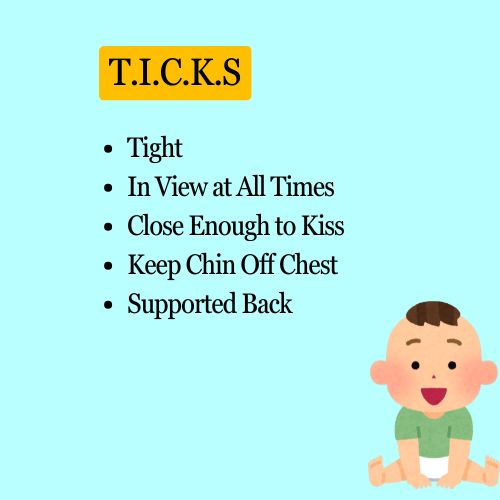
- Tight: The carrier should hold the baby snugly.
- In view: Baby’s face should always be visible.
- Close enough to kiss: Baby should be high on your chest.
- Keep chin off the chest: Baby’s chin should not tuck in too tightly.
- Supported back: Baby’s back should be supported in a natural curve.
Following these steps will ensure your newborn is safe, comfortable, and well-supported in the carrier.
Age and Time Limits for Baby Carriers
You should be consider the age limit for baby wearing.
Appropriate Age to Start Using a Carrier
- Newborns (0–4 months)
- Most baby carriers are safe for newborns with proper head, neck, and hip support.
- Look for carriers specifically designed for newborns or use infant inserts.
- Older Babies (4+ months)
- Once your baby can hold their head up independently (around 4–6 months), you can transition to carriers that allow outward-facing positions or back carrying.
How Long Babies Can Stay in Carriers Safely
Below are the guidelines for the time limits for the safe baby wearing.
- General Guidelines
- Newborns and young babies: Limit carrier use to 1–2 hours to prevent overloading delicate joints or restricting airflow.
- Older babies: As they gain strength and mobility, they can spend more time in the carrier, provided they remain comfortable and well-supported.
- Factors to Monitor
- Baby’s Comfort: Watch for signs of discomfort, such as fussiness or a reclined position.
- Parent’s Comfort: Ensure the carrier distributes weight evenly to avoid strain on your back or shoulders.
- Temperature: Babies can overheat quickly in carriers, so dress them appropriately and ensure ventilation.
- Regular Breaks
- Always take breaks to let your baby move freely and stretch, especially during long outings.
- For newborns, schedule breaks to check on feeding and diaper changes.
Key Takeaway
Carriers are safe from birth if used correctly, but time limits should be observed. Adjust the carrier and position as your baby grows to ensure comfort and safety for both of you.
Related Article: How long is it ok to have a baby in a carrier
Baby Carrier Age Limit: What You Need to Know
Baby carriers are versatile tools for parents, but using them safely and appropriately for your child’s age and developmental stage is essential. Here’s a guide to understanding age limits for baby carriers:
Newborns to 4 Months
- Recommended Carrier Type: Soft-structured carriers, wraps, or slings that support a strong head and neck.
- Key Considerations: Newborns have weak neck muscles and need support to open their airways. During this stage, always use the inward-facing position.
- Weight Limit: Most carriers are suitable for babies weighing at least 7 lbs (3.2 kg).
4 Months to 12 Months
- Recommended Carrier Type: Soft-structured carriers with adjustable seating.
- Key Considerations: Babies develop stronger neck muscles around 4 months and may enjoy outward-facing positions for short periods, but always ensure their hips remain in the M-shaped position.
Related Article: What are soft structured carriers
12 Months to 3 Years
- Recommended Carrier Type: Backpack-style carriers or structured carriers designed for toddlers.
- Key Considerations: At this stage, carriers are helpful for travel or long walks. Ensure your carrier can support your child’s weight and has adequate back and shoulder support.
- Weight Limit: Some toddler carriers can accommodate up to 45 lbs (20.4 kg).
General Age and Weight Limits
- Newborn Carriers: Typically for babies 7–25 lbs (3.2–11.3 kg).
- Standard Carriers: For infants and toddlers up to 35 lbs (15.8 kg).
- Toddler-Specific Carriers: These are for children up to 45 lbs (20.4 kg) or approximately 3–4 years old.
When to Stop Using a Baby Carrier
- Developmental Milestones: Once your child can walk confidently for long periods, you may no longer need a carrier.
- Comfort: If carrying your child causes discomfort for you or them, it may be time to stop or upgrade to a toddler carrier.
- Weight Capacity: Always follow the manufacturer’s guidelines for the carrier’s maximum weight limit.
Related Article: When should i stop babywearing
Common Mistakes When Using Baby Carriers
Avoid these mistakes for the safe babywear.
Mispositioning
- Head and neck support:
- A newborn’s head should be upright and not tilted forward to prevent airway obstruction.
- Hip position:
- Ensure the baby’s legs form an “M“ shape (knees higher than the hips) to avoid hip dysplasia.
- Slouching:
- The baby’s back should be gently curved, not slumped, to prevent spinal strain and breathing issues.
Overuse and Potential Effects
- Prolonged use without breaks may lead to:
- Restricted movement: Limiting the baby’s ability to stretch and develop motor skills.
- Parent discomfort: Back or shoulder strain from carrying too long without adjustment.
Using Non-Recommended Carriers
- Carriers without proper ergonomic design can:
- Increase the risk of hip dysplasia.
- Put undue strain on the baby’s spine.
- The cause of discomfort for the parent is poor weight distribution.
Why Some Babies Dislike Baby Carriers
Some babies does not like baby carries , these are possible reasons .
Possible Reasons for Discomfort
- Wrong fit:
- The carrier may not be adjusted correctly, causing the baby to feel restricted or unsupported.
- Overheating:
- Babies can feel too warm if dressed heavily or in carriers without good airflow.
- Hunger or tiredness:
- A baby may resist the carrier if hungry, tired, or need a diaper change.
- Position preference:
- Some babies may dislike inward-facing or particular carrying styles.
- Age factor:
- Older, curious babies may prefer more freedom to see their surroundings.
How to Address These Issues
- Check fit and comfort:
- Ensure proper adjustment for both you and the baby.
- Use an ergonomic carrier suited to the baby’s age and size.
- Dress appropriately:
- Keep the baby lightly dressed to avoid overheating.
- Experiment with positions:
- Try switching to an outward-facing or hip-carry position as the baby grows.
- Introduce gradually:
- Allow short, positive experiences in the carrier to help the baby adjust.
- Pay attention to needs:
- Ensure the baby is fed, well-rested, and comfortable before placing them in the carrier.
Key Takeaway
Ensure the baby is positioned safely and comfortably in an ergonomic carrier to avoid common mistakes. Adjust the fit, timing, or carrying style to address potential reasons for dislike.
Guidelines for Baby Carrier Safety (American Academy of Pediatrics):
- Avoid carriers for certain infants:
- Do not use backpacks or upright carriers for infants born prematurely or with respiratory issues, as they may struggle to breathe.
- Sling safety:
- Ensure the baby’s body is not curled into a “C” shape to prevent breathing problems.
- Keep the baby’s neck straight and head above the sling’s fabric.
- Face visibility:
- You should regularly check that you can see your baby’s face and ensure the fabric does not block the baby’s mouth or nose.
- Correct size and material:
- Use carriers that are the right size for your child.
- Choose sturdy materials that support the baby’s back and prevent slipping through leg holes.
- Backpack safety:
- Aluminum frames should be padded to protect the baby from injuries caused by bumps.
- Inspect carriers regularly:
- Check for ripped seams or fasteners to ensure safety.
- Proper bending technique:
- Bend at your knees, not your waist, to avoid the baby falling out and to protect your back.
- Use restraining straps:
- Always secure the baby with restraining straps and ensure the baby is seated before moving.
Choosing the Right Baby Carrier
These are the key features to look for.
Features to Prioritize
- Ergonomics:
- Supports the baby’s natural “M“ position (knees above hips).
- Adjustable straps and padded support for parents to distribute weight evenly.
- Safety Certifications:
- Look for carriers certified by organizations like the International Hip Dysplasia Institute or those meeting ASTM standards.
- Age and Weight Suitability:
- Ensure the carrier is appropriate for your baby’s current size and development stage (e.g., newborn inserts for younger babies).
- Breathable Materials:
- Lightweight, breathable fabrics to keep the baby cool and comfortable.
- Ease of Use:
- Choose designs that are easy to put on and adjust without assistance.
- Versatility:
- Look for carriers that can grow with
Frequently Asked Questions –Do baby carriers hurt babies?
1. Can baby carriers cause hip dysplasia?
Baby carriers used incorrectly or poorly designed can contribute to hip dysplasia. Choosing a carrier that supports the baby’s hips in an “M“ position (where the legs are bent and spread apart) is essential, promoting healthy hip development. Ensure the carrier offers proper support, and avoid using a carrier that forces the baby’s legs to hang straight down or puts too much pressure on the hips.
Related Article: Will baby carriers cause hip problems
2. Are they safe for newborns?
Yes, baby carriers can be safe for newborns if used properly. Ensure that the airline provides adequate newborn head, neck, and spine support. A carrier with adjustable settings or a newborn insert explicitly designed for smaller babies is ideal. Always follow the manufacturer’s guidelines to ensure safe use, and never leave the baby unattended in the carrier.
Related Article: Are carriers safe for newborns
3. Do they hurt parents’ backs?
Improper baby carrier use, such as wearing it incorrectly or for extended periods, can strain a parent’s back. To avoid this, choose a carrier that distributes the baby’s weight evenly across the body, offers good lumbar support, and is ergonomically designed. Adjust the straps properly to fit your body, and take breaks to rest if needed.
4. What are the side effects of baby carriers?
Some types of baby carriers and other equipment may interfere with healthy hip positioning. Devices like slings and wraps could inadvertently place the baby’s hips in an unhealthy position, mainly when used for long periods. To minimize this risk, ensure the carrier allows the baby’s legs to spread in an ergonomic “M-shaped” position.
5. Are baby carriers bad for a baby’s spine?
Using a baby carrier that doesn’t support the baby’s natural spinal curvature can challenge its stability or create excessive or insufficient spinal curves. This could result in structural or neurological changes over time. Always ensure the carrier provides adequate support for the baby’s spine, especially for newborns.
6. Are baby carriers uncomfortable for babies?
Yes, baby carriers can be uncomfortable if they don’t provide a natural position for the baby or fail to mold to their body. This could place pressure on undeveloped muscles, causing discomfort. Choosing an ergonomically designed carrier that supports the baby’s thighs, hips, and back can prevent discomfort.
Related Article: Baby carrier hurt my back
Do Baby Carriers Hurt Babies?-Final Words
Baby carriers are generally safe and beneficial when used correctly, but improper usage or poorly designed carriers can cause discomfort or health issues for babies. To prevent any harm:
- Ensure proper positioning: Always support the baby’s head, neck, and hips. Use carriers that allow the baby to sit in an ergonomic “M” position, with knees higher than the hips.
- Follow age-appropriate guidelines: Use carriers suited for your baby’s size and developmental stage.
- Monitor usage time: To prevent strain or overheating, avoid keeping the baby in the carrier for extended periods without breaks.
- Check the carrier quality: Choose a carrier with safety certifications and avoid low-quality or non-recommended designs.
When used mindfully, baby carriers promote bonding, convenience, and comfort for both parents and babies, making them a valuable parenting tool.
Resources Used For The Article:
- https://hipdysplasia.org
- https://www.safetyandhealthmagazine.com
- https://raisingchildren.net.au
- https://www.chaffinluhana.com
- https://www.arnoldpalmerhospital.com
- https://bwi.mystagingwebsite.com
- https://wearmybaby.co.uk
- https://www.hss.edu
- https://publications.aap.org
- https://parenting.stackexchange.com
- https://www.sciencedaily.com


